

Introduction:
Peptide Characterization Services play a critical role in the successful development of biosimilars and complex peptide therapeutics. Regulatory agencies now expect comprehensive analytical evidence demonstrating that peptide-based drug substances possess the correct molecular identity, purity, structural integrity, and impurity profile before entering clinical development or commercial manufacturing.
As peptide therapeutics become increasingly sophisticated—including cyclic peptides, peptide conjugates, long-acting peptides, modified peptides, and biosimilars—the analytical challenges become significantly more demanding. Even minor variations in amino acid sequence, post-translational modifications, oxidation, deamidation, aggregation, or synthesis-related impurities can influence safety, efficacy, stability, and regulatory acceptance.
For pharmaceutical companies developing peptide APIs, biosimilars, peptide-drug conjugates, or generic complex drugs, comprehensive characterization is no longer optional—it is a fundamental regulatory expectation.
Summary:
- Peptide characterization services confirm the identity, purity, sequence, molecular weight, impurity profile, and higher-order structural attributes of therapeutic peptides using orthogonal analytical methods.
- Advanced mass spectrometry platforms — LC-MS/MS, HRMS, Orbitrap, QTOF, and MALDI-TOF — provide the molecular-level detail regulators expect for biosimilar and complex peptide submissions.
- Biosimilar peptide products (GLP-1 analogs, insulin biosimilars, calcitonin, teriparatide) must demonstrate analytical similarity, not just clinical equivalence, to their reference product.
- Complex peptide drugs — cyclic, PEGylated, lipidated, conjugated, and long-acting formulations — require additional orthogonal characterization beyond what a standard synthetic peptide API needs.
- Regulatory agencies (FDA, Health Canada, EMA, ICH) expect a full analytical package built around Critical Quality Attributes, forced degradation data, and validated methods before a submission is considered complete.
- ResolveMass Laboratories Inc. delivers regulatory-ready peptide characterization built on a mass spectrometry-first methodology, supporting sponsors from early development through commercial lot release.
1: What Are Peptide Characterization Services?
Peptide characterization services are a defined set of analytical studies that confirm a therapeutic peptide’s identity, sequence, purity, molecular weight, impurity profile, and structural integrity before it can move into clinical development or commercial manufacturing. For sponsors pursuing peptide characterization services in a biosimilar or complex generic context, the goal is not simply to identify a molecule — it is to build a data package robust enough to withstand regulatory scrutiny and demonstrate that a peptide behaves identically, batch after batch, to its intended reference.
Unlike small-molecule APIs, peptides sit in an analytical gray zone. They are large enough to fold into secondary and higher-order structures, yet small enough that a single amino acid substitution, deamidation event, oxidation, or truncation can meaningfully change biological activity. This is why peptide characterization draws on techniques more commonly associated with protein and biologic testing — high-resolution mass spectrometry, orthogonal chromatography, and structural spectroscopy — layered on top of classical peptide QC methods.
Robust characterization helps answer the questions reviewers will inevitably ask:
- Is the amino acid sequence correct?
- Is the molecular weight accurate?
- Are impurities identified and quantified?
- Has oxidation or deamidation occurred?
- Are disulfide bonds correctly formed?
- Does the peptide maintain structural integrity through manufacturing and storage?
- Does a biosimilar peptide closely match the reference product across all critical attributes?
Without this evidence, sponsors risk regulatory delays, additional information requests, or an outright failed comparability assessment.
2: Why Is Demand for Peptide Therapeutics Growing?
Demand for peptide therapeutics is growing because peptides offer high target specificity, lower off-target toxicity, and strong biological activity compared to many small-molecule alternatives — a trend also reflected in broader generic injectable market trends. This growth is pushing more molecules, and more molecular complexity, through characterization pipelines every year.
| Therapeutic Area | Example Applications |
|---|---|
| Diabetes | GLP-1 analogues, insulin biosimilars |
| Oncology | Targeted peptide therapeutics |
| Endocrinology | Hormonal peptides |
| Cardiovascular | Natriuretic peptides |
| Rare Diseases | Replacement peptides |
| Infectious Diseases | Antimicrobial peptides |
GLP-1 receptor agonists in particular have brought peptide characterization into sharp regulatory focus, with agencies publishing more explicit expectations around GLP-1 peptide characterization regulatory requirements and GLP-1 peptide mapping regulatory requirements.
3: What Does a Peptide Characterization Program Include?
A peptide characterization program includes molecular weight confirmation, sequence verification, purity assessment, impurity profiling, disulfide bond mapping, and stability-related structural analysis, each contributing a different piece of the overall quality picture.
| Characterization Parameter | Purpose |
|---|---|
| Molecular weight confirmation | Verify correct synthesis |
| Amino acid sequence | Confirm primary structure |
| Purity assessment | Detect impurities |
| Impurity profiling | Identify synthesis by-products |
| Disulfide bond mapping | Confirm correct folding |
| Peptide mapping | Structural verification |
| Oxidation analysis | Stability evaluation |
| Deamidation analysis | Product quality monitoring |
| Aggregation assessment | Product stability |
| Higher-order structure | Structural integrity |
4: What Analytical Techniques Are Used in Peptide Characterization?
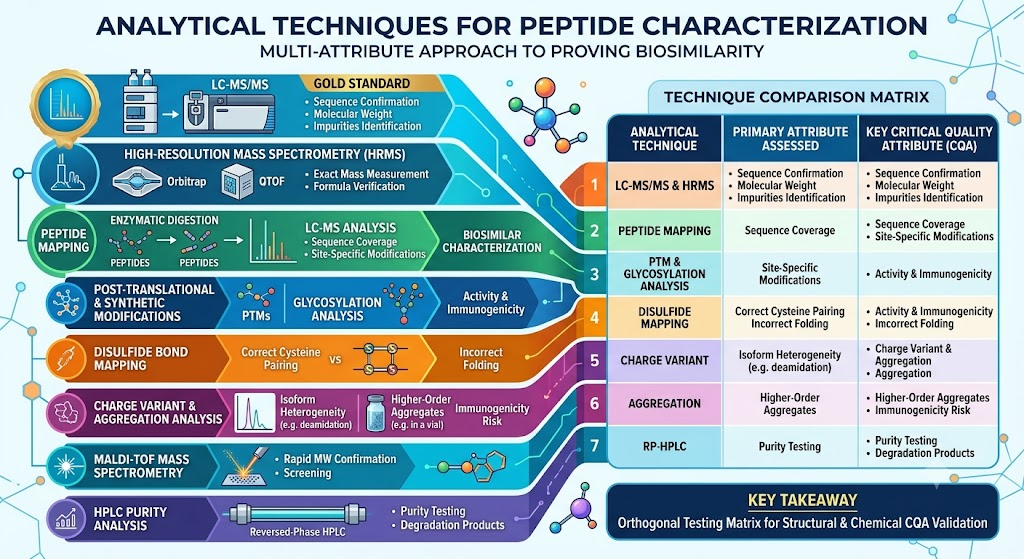
Peptide characterization relies on a combination of mass spectrometry, chromatographic, and spectroscopic techniques, each answering a different structural or purity question, and no single method provides a complete picture on its own.
LC-MS/MS
Liquid chromatography coupled with tandem mass spectrometry is considered the gold standard for peptide characterization. LC-MS/MS services for biosimilar support sequence confirmation, molecular weight determination, fragment ion analysis, impurity identification, and forced degradation studies with excellent sensitivity even in complex peptide mixtures — and are central to how sponsors prove biosimilarity using LC-MS.
High-Resolution Mass Spectrometry (HRMS)
HRMS platforms, including Orbitrap and QTOF instruments, provide highly accurate mass measurements for exact mass confirmation, molecular formula verification, unknown impurity identification, and isotope distribution analysis. Intact mass analysis and native mass spectrometry approaches extend this further, allowing structural confirmation under near-physiological conditions without disrupting non-covalent interactions.
Peptide Mapping
Peptide mapping involves enzymatic digestion followed by LC-MS analysis to confirm amino acid sequence, sequence coverage, cleavage specificity, and site-specific modifications. Peptide mapping in biosimilars and broader peptide mapping and sequence analysis workflows, often supported by a proteomics approach for biosimilars, remain one of the most important tools for demonstrating regulatory-grade comparability. For biosimilar peptides specifically, peptide biosimilar characterization using LC-MS ties sequence and modification data directly to comparability conclusions.
Post-Translational and Synthetic Modifications
Many therapeutic peptides carry modifications that must be precisely located and quantified. Post-translational modifications (PTMs) in biosimilars and glycosylation analysis of biosimilars are especially critical for glycopeptides and fusion peptide constructs, where even minor glycoform shifts can affect activity or immunogenicity.
Disulfide Bond Mapping
Correct disulfide bond formation is essential for many therapeutic peptides, and disulfide bond mapping in biosimilars confirms correct cysteine pairing, folding integrity, and manufacturing consistency. Incorrect disulfide pairing can significantly alter biological activity even when the underlying sequence is correct.
Charge Variant and Aggregation Analysis
Charge variant analysis in biosimilars profiles isoform heterogeneity arising from deamidation, oxidation, or C-terminal processing. Separately, aggregation analysis in biosimilars and more targeted biosimilar aggregation analysis studies assess higher-order aggregate formation, a key immunogenicity risk factor.
MALDI-TOF Mass Spectrometry
MALDI-TOF enables rapid molecular weight confirmation and screening, supporting batch confirmation, identity testing, peptide fingerprinting, and routine quality control checks.
HPLC Purity Analysis
Reverse-phase HPLC remains a core release test, evaluating purity, related substances, process impurities, degradation products, and batch-to-batch consistency.
5: Why Does Peptide Characterization Matter for Biosimilars?
Peptide characterization matters for biosimilars because regulatory agencies require analytical similarity data, not just clinical equivalence, before approving a peptide biosimilar or complex generic. The objective for biosimilar developers is not merely to characterize the product, but to demonstrate analytical similarity against the reference product — a distinction explored in depth in peptide sameness vs. biosimilar comparability and reinforced by the broader totality of evidence approach in biosimilar approval.
A comprehensive biosimilar comparability study typically includes:
- Sequence verification and peptide mapping
- Molecular weight comparison
- Impurity comparison
- PTM and glycosylation profiling
- Stability comparison
- Batch-to-batch consistency
- Orthogonal analytical confirmation
For insulin and GLP-1 analogs specifically, insulin biosimilar characterization and GLP-1 biosimilar characterization programs illustrate how analytical strategy needs to be tailored to the therapeutic class, not applied as a one-size-fits-all template. It’s also worth understanding how these expectations diverge from small-molecule generics — see biosimilar vs. generic drug differences — since the two development pathways carry very different analytical burdens.
6: What Critical Quality Attributes Should Be Monitored?
Regulatory agencies expect sponsors to identify and monitor Critical Quality Attributes (CQAs) throughout development, and a well-designed CQA framework for biosimilars ties directly back to patient safety and efficacy risk.
| Critical Quality Attribute | Importance |
|---|---|
| Identity | Confirms correct product |
| Molecular Weight | Detects synthesis errors |
| Sequence Integrity | Ensures therapeutic activity |
| Purity | Safety and efficacy |
| Related Impurities | Regulatory compliance |
| Oxidation | Stability monitoring |
| Deamidation | Product consistency |
| Aggregation | Immunogenicity risk |
| Disulfide Bonds | Structural integrity |
7: How Does Peptide Characterization Differ for Complex Drug Applications?
Peptide characterization for complex drug applications requires additional structural and stability studies beyond what a standard synthetic peptide API needs, because complexity introduces new failure modes that regulators specifically ask sponsors to address. Complex peptide products generally fall into a few categories:
- PEGylated and lipidated peptides — require confirmation of modification site, degree of substitution, and modification-related impurities alongside the peptide backbone itself.
- Cyclic and branched peptides — need ring-closure confirmation and assessment of linear or open-chain impurity variants.
- Peptide-drug and peptide-oligonucleotide conjugates — require conjugation efficiency, linker stability, and payload release characterization in addition to sequence confirmation.
- Long-acting or depot peptide formulations — often paired with PLGA or other polymer delivery systems, where peptide-PLGA interaction analysis becomes essential to understanding release-rate behavior alongside the peptide’s own stability profile.
Each of these adds analytical layers on top of standard peptide mapping and purity testing, and each generally needs a bespoke method development phase rather than a fully compendial approach.
8: What Impurities Does Peptide Characterization Identify?
Peptide characterization identifies both process-related and product-related impurities, and impurity profiling of biosimilars is one of the most scrutinized sections of any regulatory submission.
- Process-related impurities — deletion sequences, addition sequences, truncated peptides, amino acid substitutions, incomplete deprotection products
- Product-related impurities — oxidized peptides, deamidated species, aggregates, dimers, misfolded peptides, hydrolysis products
Comprehensive impurity identification supports process optimization as much as it supports regulatory compliance, since many of these impurities point directly to a specific step in synthesis or formulation that can be corrected.
9: What Should a Regulatory Submission Package Include?
A regulatory-ready peptide characterization package should include sequence confirmation, purity and impurity data, stability and forced degradation results, and reference standard qualification documentation organized to CTD Module 3 format. A clear list of analytical tests for biosimilar regulatory submission helps sponsors avoid the most common reviewer information requests.
A well-structured package typically includes:
- Primary structure confirmation (sequence, molecular weight, modifications)
- Purity determination by two or more orthogonal methods
- Process-related and degradation-related impurity identification and quantification
- Forced degradation of biosimilars and dedicated biosimilar forced degradation studies under thermal, oxidative, hydrolytic, and photolytic stress
- Reference standard characterization and qualification records
- Analytical method validation data (specificity, accuracy, precision, linearity, robustness)
- Biosimilar stability testing and batch-to-batch comparability data across multiple lots
- A defined bioanalytical strategy for drug development, supported by broader biosimilar bioanalysis capabilities where PK/PD data is also required
Relevant guidance documents sponsors should build their package against include ICH Q6B, ICH Q2(R2), ICH Q14, FDA peptide drug product guidance, EMA biosimilar guidelines, and Health Canada quality guidance. Understanding how expectations diverge between agencies — see FDA vs. EMA biosimilar regulatory pathways — is particularly useful for sponsors planning multi-region filings.
10: What Immunogenicity-Related Testing Supports Peptide Characterization?
Structural characterization alone doesn’t fully address immunogenicity risk, which is why immunogenicity assessment in biosimilar development is typically run alongside physicochemical characterization. This often includes anti-drug antibody (ADA) assay development, since aggregation, PTM shifts, and impurity load identified during characterization can all directly influence ADA risk.
For cell-based or fusion peptide products, upstream considerations such as cell line development for biosimilars also feed into the eventual characterization strategy, since clonal variability can introduce structural heterogeneity that characterization studies later need to detect and explain.
11: Why Do Some Biosimilar and Complex Peptide Submissions Fail?
Biosimilar and complex peptide submissions most often fail due to incomplete impurity characterization, insufficient orthogonal method coverage, or comparability data that doesn’t adequately bracket reference product variability. A closer look at why biosimilars fail regulatory approval and documented cases of biosimilar comparability failure shows that most gaps trace back to underinvestment in characterization breadth early in development, rather than a single dramatic analytical miss.
Common technical challenges include:
- Structural complexity and multiple degradation pathways
- Labile modifications that are easy to lose during sample preparation
- Low-level impurities near the limit of detection
- Highly similar analogues and isomeric species
- Complex fragmentation patterns that require experienced interpretation
Addressing these challenges requires experienced scientists, validated workflows, and advanced analytical instrumentation — not just access to the instruments themselves.
12: Why Work With a Specialized CRO for Peptide Characterization Services?
Working with a specialized CRO for peptide characterization services gives sponsors access to mass spectrometry expertise, GMP-aligned documentation practices, and cross-jurisdictional regulatory familiarity that in-house teams often lack, particularly for smaller biosimilar and generic developers. Peptide characterization sits at the intersection of small-molecule and biologic analytical science, and few labs maintain deep capability in both — a gap that dedicated biosimilar characterization services and biosimilar characterization using mass spectrometry capabilities are built to close.
ResolveMass Laboratories Inc. approaches peptide characterization from a mass spectrometry-first perspective, applying the same rigor used in biosimilar higher-order structure and comparability work to peptide sequence confirmation, impurity profiling, and modification mapping. This matters in practice: a lab that primarily runs routine HPLC purity testing may miss a low-level truncation impurity or a site-specific oxidation event that only high-resolution MS fragmentation can detect — and that a reviewer may specifically ask about.
For sponsors managing submissions across both the United States and Canada, working with a single testing partner familiar with FDA and Health Canada expectations, and with the broader Canadian generic pharmaceutical CDMO landscape, can also reduce the risk of generating two incompatible data packages for what is functionally the same molecule.
Our Peptide Characterization Services include:
- LC-MS/MS analysis
- High-resolution mass spectrometry (Orbitrap, QTOF)
- MALDI-TOF analysis
- Peptide mapping and sequence confirmation
- Disulfide bond mapping
- Molecular weight determination
- Purity and impurity profiling
- Forced degradation and stability studies
- Comparative biosimilar characterization
- Regulatory-ready analytical reports aligned to CTD Module 3
Benefits of Comprehensive Peptide Characterization
A complete characterization strategy offers several practical advantages: faster product development, improved manufacturing control, better regulatory readiness, and reduced development risk. Early analytical investment often reduces costly redevelopment later in the product lifecycle, particularly when characterization data is generated before formulation decisions are locked in rather than after.
Conclusion:
Peptide Characterization Services have become indispensable for the development of biosimilars and complex peptide therapeutics. Comprehensive analytical characterization not only confirms molecular identity, purity, and structural integrity but also provides the robust scientific evidence regulatory agencies require for successful submissions. By integrating advanced mass spectrometry, peptide mapping, impurity profiling, and orthogonal analytical techniques, developers can reduce development risks, improve manufacturing consistency, and accelerate product approval.
At ResolveMass Laboratories Inc., our peptide characterization services are designed to support every stage of peptide drug development — from early research through regulatory submission — with high-quality analytical data, scientific expertise, and regulatory-ready documentation.
Frequently Asked Questions:
Biosimilar development requires manufacturers to demonstrate that their product is highly similar to an approved reference product. Comprehensive peptide characterization is the foundation of this comparability assessment.
Through advanced analytical testing, developers can compare:
-Primary amino acid sequence
-Molecular weight
-Impurity profile
-Peptide purity
-Oxidation and deamidation levels
-Disulfide bond arrangement
-Product-related variants
-Stability characteristics
Regulatory agencies such as the FDA, EMA, and Health Canada place significant emphasis on analytical similarity. The more comprehensive the analytical characterization, the greater the confidence that any observed differences are not clinically meaningful. This can streamline regulatory review and reduce uncertainty during development.
Peptide mapping is one of the most powerful analytical techniques used to confirm the primary structure of therapeutic peptides and proteins. During peptide mapping, the molecule is enzymatically digested into smaller fragments, which are then separated by liquid chromatography and analysed using mass spectrometry.
Peptide mapping helps scientists:
-Verify the complete amino acid sequence
-Confirm sequence coverage
-Detect amino acid substitutions
-Identify oxidation and deamidation sites
-Locate post-translational modifications
-Confirm disulfide bond locations
-Compare biosimilars with reference products
Because peptide mapping provides detailed molecular information, it is considered a cornerstone of regulatory submissions for biosimilars and complex peptide drugs.
Therapeutic peptides may contain impurities originating from synthesis, purification, storage, or degradation. Comprehensive characterization enables both identification and quantification of these impurities.
Common process-related impurities include:
-Truncated peptides
-Deletion sequences
-Addition sequences
-Incomplete coupling products
-Protecting group residues
-Synthetic intermediates
Product-related impurities include:
-Oxidized peptides
-Deamidated peptides
-Hydrolysed peptides
-Aggregates
-Dimers
-Misfolded peptides
-Isomeric variants
Detecting these impurities early helps optimise manufacturing processes, improve product stability, and ensure regulatory compliance.
Common CQAs include:
-Molecular identity
-Amino acid sequence
-Molecular weight
-Purity
-Related impurities
-Disulfide bond formation
-Oxidation
-Deamidation
-Aggregation
-Stability
Monitoring these attributes ensures consistent product quality throughout development.
Disulfide bonds play a crucial role in maintaining the correct three-dimensional structure of many therapeutic peptides. Incorrect disulfide bond formation can significantly affect biological activity, stability, potency, and safety.
Disulfide bond mapping helps:
-Confirm correct cysteine pairing
-Verify structural integrity
-Detect incorrect disulfide linkages
-Monitor manufacturing consistency
-Support biosimilar comparability studies
-Ensure regulatory compliance
Advanced LC-MS/MS techniques enable precise identification of disulfide bond connectivity, making this analysis an important component of peptide characterization.
Although no single guideline covers every aspect of peptide characterization, several international regulations provide expectations for analytical characterization.
Key regulatory references include:
ICH Q6B – Specifications for Biotechnological/Biological Products
ICH Q2(R2) – Validation of Analytical Procedures
ICH Q14 – Analytical Procedure Development
FDA Guidance for Peptide Drug Products
EMA Guidelines for Biosimilars
Health Canada Quality Guidance Documents
These guidelines encourage comprehensive analytical characterization to demonstrate product identity, purity, consistency, stability, and comparability before regulatory approval.
Peptide purity testing measures the percentage of the desired peptide relative to impurities, typically using HPLC. Peptide characterization is broader and includes purity testing along with sequence verification, molecular weight confirmation, impurity identification, structural analysis, and stability evaluation.
Reference
- Guttman A, Rathore AS, Krull IS. Bioanalytical tools for the characterization of biologics and biosimilars. LC. GC Magazine. 2012 May 1;30:412-21.https://www.chromatographyonline.com/view/bioanalytical-tools-characterization-biologics-and-biosimilars
- Berkowitz SA, Engen JR, Mazzeo JR, Jones GB. Analytical tools for characterizing biopharmaceuticals and the implications for biosimilars. Nature reviews Drug discovery. 2012 Jul;11(7):527-40.https://www.nature.com/articles/nrd3746
- DeLaney K, Ippoliti S, Birdsall RE, Yu YQ. Peptide characterization and monitoring workflow for biosimilar mab drug products using a compliance ready lc-ms and informatics platform.https://www.frontiersin.org/journals/bioengineering-and-biotechnology/articles/10.3389/fbioe.2022.832059/full
- Berkowitz SA. Analytical characterization: structural assessment of biosimilarity. InBiosimilar drug product development 2017 Feb 24 (pp. 15-82). CRC Press.https://bpspubs.onlinelibrary.wiley.com/doi/abs/10.1002/prp2.604
- Beck A, Sanglier-Cianférani S, Van Dorsselaer A. Biosimilar, biobetter, and next generation antibody characterization by mass spectrometry. Analytical chemistry. 2012 Jun 5;84(11):4637-46.https://pubs.acs.org/doi/full/10.1021/ac3002885
About the Author


