

Introduction:
Developing a biosimilar monoclonal antibody involves far more than demonstrating analytical similarity with the reference product. One of the most critical activities is performing Forced Degradation Studies for Biosimilars, which reveal potential degradation pathways, establish stability-indicating analytical methods, and help predict long-term stability risks.
For biosimilars such as Bevacizumab, stress testing provides valuable information about how the molecule behaves under extreme environmental conditions. These studies allow developers to understand product robustness, optimize formulations, improve manufacturing processes, and prepare comprehensive regulatory submissions.
This case study illustrates how a structured forced degradation strategy can proactively identify stability risks during a Bevacizumab biosimilar development programme while supporting analytical similarity and quality-by-design (QbD) principles.
Summary:
- Forced Degradation Studies for Biosimilars intentionally expose a candidate molecule to thermal, oxidative, photolytic, mechanical, and pH stress to reveal degradation pathways before they surface in real-time stability studies.
- Bevacizumab biosimilars carry multiple structural vulnerabilities — disulfide bonds, glycosylation, methionine residues, asparagine residues, and Fc region aggregation sites — that all require dedicated stress evaluation.
- A scientifically designed forced degradation strategy establishes stability-indicating analytical methods, strengthens analytical similarity assessments, and directly supports quality-by-design (QbD) and regulatory submission requirements.
- This case study walks through a representative ResolveMass stress testing programme for a bevacizumab biosimilar — baseline characterization, stress conditions applied, the orthogonal analytical panel used, degradation pathways identified, and how the findings shaped formulation and regulatory strategy.
- Early investment in forced degradation testing reduces development delays, manufacturing failures, and regulatory findings later in the programme.
1: What Are Forced Degradation Studies for Biosimilars?
Forced Degradation Studies for Biosimilars are accelerated stress experiments that intentionally push a biologic past its normal storage conditions to reveal how, where, and how fast it degrades. Unlike routine stability testing, which tracks a product under labeled storage conditions over months or years, forced degradation compresses that timeline into days to weeks — generating the kind of degradation products that would otherwise take a year or more of real-time storage to appear.
Unlike small molecules, monoclonal antibodies possess highly complex higher-order structures that are sensitive to numerous, often interacting, degradation processes. These studies help developers identify degradation pathways, develop and confirm stability-indicating analytical methods, compare degradation profiles against the reference biologic, evaluate formulation robustness, support shelf-life assignment, and strengthen the overall analytical similarity package. Regulatory agencies expect scientific justification that analytical methods can reliably distinguish intact molecules from degraded forms — and forced degradation is the exercise that generates that proof.
2: Why Bevacizumab Requires Extensive Stress Testing
Bevacizumab is a recombinant humanized IgG1 monoclonal antibody (~149 kDa) targeting vascular endothelial growth factor (VEGF-A). Its large, glycosylated structure carries several well-documented stability risk points:
| Structural Feature | Stability Risk |
|---|---|
| Multiple disulfide bonds | Reduction, scrambling |
| Glycosylation | Glycan alterations, sialic acid loss |
| Higher-order structure | Partial unfolding, conformational shifts |
| Methionine residues | Oxidation |
| Asparagine residues | Deamidation |
| Fc region | Aggregation |
| Variable (CDR) regions | Fragmentation, binding loss |
Even slight structural modifications at any of these sites can influence biological activity, binding affinity, pharmacokinetics, immunogenicity, product safety, and ultimately regulatory acceptance. Because bevacizumab is handled across multiple points in a cold chain — manufacturing, bulk storage, shipping, hospital pharmacy storage, dilution, and IV administration — a biosimilar sponsor needs stress data covering realistic mishandling scenarios, not just idealized long-term storage. This is why degradation behavior must be characterized thoroughly and early, rather than left to be discovered during pivotal stability studies.
Objectives of the Forced Degradation Programme
The primary objective of a forced degradation programme is to understand how a biosimilar candidate degrades under different stress conditions and to confirm that analytical methods accurately detect those changes. A well-scoped programme is typically designed to:
- Establish the molecule’s major degradation pathways
- Compare degradation behavior directly against the reference product
- Develop and validate stability-indicating assays
- Confirm analytical method specificity for each known degradation product
- Predict potential long-term stability failures before they occur
- Optimize formulation, buffer, and container closure selection
- Generate data that supports ICH-aligned stability studies
- Produce regulatory-ready, well-documented datasets
Typical Stress Conditions Evaluated
A comprehensive stress testing programme evaluates multiple degradation mechanisms in parallel, since each stress condition is designed to target a different pathway.
| Stress Condition | Purpose |
|---|---|
| Heat | Protein unfolding, aggregation |
| Acidic pH | Denaturation, partial unfolding |
| Basic pH | Deamidation |
| Oxidation (H₂O₂) | Methionine and tryptophan oxidation |
| Light exposure (ICH Q1B) | Photodegradation, oxidation |
| Freeze-thaw cycling | Aggregation, particle formation |
| Mechanical agitation | Sub-visible and visible particle formation |
| High ionic strength | Structural instability |
3: Case Study: Stress Testing Design for a Bevacizumab Biosimilar Programme
Product: Bevacizumab biosimilar candidate Development stage: Analytical similarity assessment, supported by early cell line development and process characterization work Primary goal: Predict long-term stability risks before initiating commercial stability studies
Step 1: Baseline Analytical Characterization
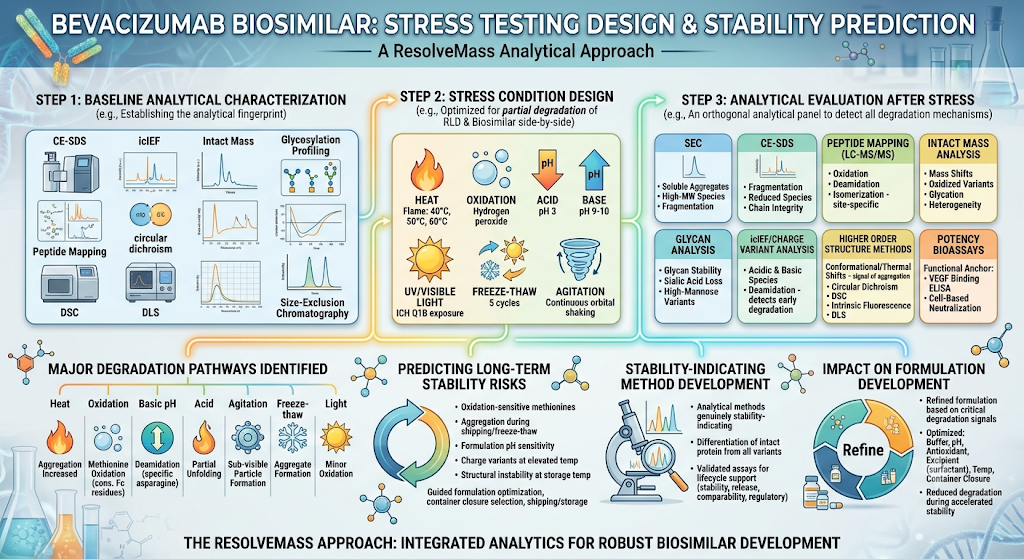
Before any stress was applied, the biosimilar candidate underwent extensive baseline characterization to establish an analytical fingerprint for later comparison. This included peptide mapping, CE-SDS, imaged capillary isoelectric focusing (icIEF), intact mass analysis, glycosylation profiling, circular dichroism, differential scanning calorimetry, and dynamic light scattering — the same panel used broadly across ResolveMass’s biosimilar characterization services.
Step 2: Stress Condition Design
Each stress condition was carefully optimized to generate partial degradation rather than complete destruction, since over-stressed samples produce non-physiological artifacts that complicate interpretation.
| Stress | Example Conditions |
|---|---|
| Heat | 40°C, 50°C, 60°C |
| Oxidation | Hydrogen peroxide (0.1–0.5% H₂O₂) |
| Acid | pH 3 |
| Base | pH 9–10 |
| UV/visible light | ICH Q1B option 2 exposure |
| Freeze-thaw | Five cycles (-20°C/25°C) |
| Agitation | Continuous orbital shaking |
Reference-listed drug and biosimilar candidate were stressed side by side, from the same formulation buffer and protein concentration, at matched timepoints — a detail regulators check closely, since mismatched stress conditions between molecules is one of the most common reasons sponsors are asked to repeat a forced degradation study.
Step 3: Analytical Evaluation After Stress Exposure
No single technique captures every degradation mechanism in a monoclonal antibody, so each stressed sample underwent a full orthogonal analytical panel.
Size-Exclusion Chromatography (SEC) detected soluble aggregates, high-molecular-weight species, and fragment formation — the primary quantitative measure of aggregation and fragmentation.
CE-SDS measured fragmentation, reduced species, and heavy/light chain integrity, complementing disulfide bond mapping work used to characterize reduction and scrambling.
Peptide mapping using LC-MS/MS, part of ResolveMass’s broader proteomics approach for biosimilars, detected oxidation, deamidation, isomerization, and other site-specific sequence modifications — pinpointing exactly which methionine or asparagine residues were affected.
Intact mass analysis, supported by native mass spectrometry approaches, confirmed mass shifts, oxidized variants, glycation, and overall molecular heterogeneity.
Glycan analysis evaluated glycan stability, sialic acid loss, and high-mannose variant formation under stress.
icIEF and CEX-based charge variant analysis measured acidic species, basic species, and deamidation products — often detecting degradation well before it became visible by SEC alone.
Higher-order structure methods — circular dichroism, DSC, intrinsic fluorescence, and dynamic light scattering — monitored conformational and thermal stability shifts after stress, catching subtle changes before aggregation became visible.
Potency bioassays (VEGF binding ELISA and cell-based neutralization) confirmed whether structural changes observed across the panel translated into a measurable loss of biological function, giving the programme a functional anchor for interpreting the structural data.
Major Degradation Pathways Identified
| Stress Condition | Major Observation |
|---|---|
| Heat | Aggregation increased |
| Oxidation | Methionine oxidation (localized to conserved Fc residues) |
| Basic pH | Deamidation at specific asparagine residues |
| Acid | Partial unfolding |
| Agitation | Sub-visible particle formation |
| Freeze-thaw | Aggregate formation |
| Light | Minor oxidation |
Each degradation pathway remained clearly distinguishable using the orthogonal analytical panel, which is the outcome regulators are ultimately looking for — confirmation that no single degradation route can slip past the testing strategy undetected.
Predicting Long-Term Stability Risks
Forced degradation cannot replace real-time stability studies, but it effectively predicts likely stability risks and informs mitigation strategies well ahead of pivotal studies. The programme identified several potential concerns: oxidation-sensitive methionine residues, aggregation risk during shipping and freeze-thaw handling, formulation pH sensitivity, charge variant formation under elevated temperature, and structural instability at higher storage temperatures. These findings directly guided formulation optimization, container closure selection, and storage/shipping recommendations — turning a one-time comparability exercise into a practical risk map for the rest of development.
Stability-Indicating Method Development
One of the most important outcomes of a forced degradation programme is confirmation that the analytical methods used are genuinely stability-indicating. In this case, the panel successfully differentiated intact protein from oxidized variants, aggregates, fragments, charge variants, and deamidated species — and detection of low-level impurities at each stress condition confirmed method sensitivity. These validated assays go on to support ongoing stability studies, batch release testing, comparability exercises, and regulatory submissions throughout the product’s lifecycle.
Impact on Formulation Development
Stress testing data directly informed formulation optimization. Buffer selection, pH range, antioxidant strategy, excipient (surfactant) concentration, storage temperature, and container closure selection were all refined based on which stress conditions produced the most pronounced degradation signals. This reduced degradation observed during subsequent accelerated stability testing, and gave the formulation team a defensible, data-driven basis for every change made.
4: How Forced Degradation Data Supports Regulatory Submissions
Health authorities expect scientifically justified stress studies for biologics, and a comprehensive forced degradation programme supports analytical method validation, stability-indicating assay development, comparability exercises, shelf-life justification, specification setting, root cause investigations, change control, and lifecycle management. The dataset also strengthens the analytical tests required for a biosimilar regulatory submission under both the FDA’s stepwise approach and EMA’s comparability framework — two pathways that, while broadly aligned, differ in specific expectations, as outlined in our comparison of FDA vs. EMA biosimilar regulatory pathways. Forced degradation data is also a core input into the totality-of-evidence approach to biosimilar approval, where analytical, functional, and clinical data are weighed together rather than any single dataset carrying the argument alone.
Correlating degradation findings with critical quality attributes (CQAs) is what ties the whole exercise together for reviewers — it demonstrates not just that degradation was observed, but that its impact on the attributes regulators actually care about was assessed and understood.
5: Common Pitfalls in Biosimilar Stress Testing Programmes
- Testing biosimilar and reference product under non-identical conditions, a frequent contributor to biosimilar comparability failure and a common reason regulators request repeat studies
- Relying on a single analytical method and missing charge-based or sequence-level degradation entirely
- Under-stressing or over-stressing the molecule, either producing too little degradation to be meaningful or generating non-physiological artifacts
- Skipping potency correlation, so structural changes are documented without confirming their effect on biological activity
- Not localizing modifications to specific residues, leaving reviewers to guess whether a change falls in a functionally critical region
- Underestimating immunogenicity risk from degradation products — a factor closely tied to immunogenicity assessment in biosimilar development and often evaluated alongside anti-drug antibody (ADA) assay development
These same gaps are frequently cited among the broader reasons why biosimilars fail regulatory approval, which makes a rigorous forced degradation programme one of the highest-leverage investments early in development.
6: Best Practices for Forced Degradation Studies for Biosimilars
To maximize scientific and regulatory value, developers should:
- Design stress conditions that induce partial degradation rather than complete destruction
- Use orthogonal analytical techniques, including LC-MS/MS-based services, to capture multiple degradation mechanisms
- Compare degradation profiles with the reference product whenever feasible, under matched conditions
- Include appropriate controls and replicate samples
- Evaluate both physical degradation (aggregation, particles) and chemical degradation (oxidation, deamidation) pathways
- Document degradation kinetics across multiple timepoints rather than a single endpoint
- Correlate analytical findings with critical quality attributes
- Use study outcomes to refine formulations, bioanalytical strategy, and manufacturing processes
Following these practices improves data reliability and directly supports regulatory expectations across both FDA and EMA pathways.
7: How ResolveMass Laboratories Supports Biosimilar Stability Programmes
ResolveMass Laboratories Inc. provides comprehensive analytical solutions for biosimilar characterization and stability assessment, built around a scientific team that works closely with sponsors to identify degradation pathways early and generate regulatory-ready datasets. Our capabilities span:
- Forced degradation study design and stress testing strategy
- Stability-indicating method development and GLP bioanalytical services
- Peptide mapping and sequence analysis using high-resolution LC-MS/MS
- Biosimilar characterization using mass spectrometry, including intact mass and native MS workflows
- Glycosylation, charge variant, and aggregate characterization
- Comparative biosimilar comparability studies and analytical similarity assessments
- Support across modalities, including peptide biosimilar characterization and insulin biosimilar characterization
- Method validation, technology transfer, and regulatory-ready analytical reporting
This breadth reflects a broader distinction our team is often asked to explain to sponsors and stakeholders new to the space — the practical differences between biosimilars and generic drugs, and why analytical rigor plays such an outsized role in biosimilar development compared to small-molecule generics.
Conclusion:
Forced Degradation Studies for Biosimilars play a critical role in predicting stability risks, understanding degradation pathways, and establishing robust stability-indicating analytical methods. For complex monoclonal antibodies such as bevacizumab, a well-designed stress testing programme provides valuable insight into aggregation, oxidation, deamidation, fragmentation, and higher-order structural changes long before these issues emerge during long-term storage.
By integrating orthogonal analytical techniques with scientifically designed stress conditions, developers can optimize formulations, strengthen analytical similarity packages, and support regulatory expectations with confidence. Early investment in Forced Degradation Studies for Biosimilars ultimately reduces development risk, accelerates decision-making, and contributes to the successful commercialization of safe, effective, and high-quality biosimilar products.
Frequently Asked Questions:
Monoclonal antibodies are typically exposed to thermal stress, acidic and alkaline pH, oxidative agents, UV or visible light, freeze-thaw cycles, and mechanical agitation. Each condition is selected to induce a specific degradation mechanism without completely destroying the molecule. Heat can promote aggregation, while oxidation often affects methionine residues. Acidic and basic conditions help evaluate denaturation and deamidation. Freeze-thaw studies assess product stability during storage and transportation. Mechanical stress evaluates particle formation caused by handling. Together, these stress conditions provide a comprehensive understanding of product stability.
Forced degradation studies accelerate degradation under carefully controlled conditions to reveal potential stability issues much earlier than real-time studies. Although they cannot directly predict shelf life, they identify degradation pathways that are likely to occur during storage. The results help scientists optimize formulations, packaging materials, and storage conditions before commercial manufacturing. They also support the development of stability-indicating analytical methods capable of detecting degradation products. Understanding degradation behavior allows manufacturers to reduce product failures and improve product robustness. These studies are therefore an important part of a comprehensive stability program. They complement accelerated and real-time stability studies required by regulatory agencies.
Monoclonal antibody biosimilars can undergo several types of physical and chemical degradation during development and storage. Common degradation pathways include oxidation, deamidation, aggregation, fragmentation, glycation, disulfide bond reduction, and charge variant formation. Structural changes may also occur in the higher-order structure of the protein, affecting its biological function. Some degradation products can reduce potency, while others may increase immunogenicity or alter pharmacokinetics. Forced degradation studies are designed to intentionally induce these changes under controlled conditions. Understanding these pathways helps optimize formulations and analytical methods. It also supports regulatory compliance and product lifecycle management.
Regulatory agencies such as the FDA, EMA, and ICH expect manufacturers to understand the degradation behavior of biosimilars throughout development. Although specific stress conditions may not be explicitly mandated, scientifically justified forced degradation studies are considered an industry best practice. These studies demonstrate that analytical methods are stability-indicating and capable of detecting degradation products. They also support analytical similarity assessments, specification setting, and quality risk management. Comprehensive stress testing strengthens Chemistry, Manufacturing, and Controls (CMC) documentation submitted to regulatory authorities. It provides confidence that the product will remain stable throughout its intended shelf life. As a result, forced degradation studies play an important role in regulatory approval.
Forced degradation studies identify potential stability issues early in product development, allowing corrective actions before expensive clinical or commercial stages. The results help optimize formulations, manufacturing parameters, packaging materials, and storage conditions to improve product stability. They also support the development of robust analytical methods capable of detecting degradation products throughout the product lifecycle. Early understanding of degradation pathways reduces the likelihood of unexpected stability failures during long-term studies. This minimizes regulatory delays, manufacturing challenges, and product recalls. The knowledge gained also supports Quality by Design (QbD) and risk management strategies. Overall, forced degradation studies save development time and reduce overall project costs.
A stability-indicating analytical method is specifically designed to distinguish the intact biosimilar from all potential degradation products, impurities, aggregates, and fragments. These methods remain accurate and reliable even after the product has undergone stress testing. They are essential for monitoring product quality during stability studies, batch release testing, and lifecycle management. Regulatory agencies expect these methods to demonstrate specificity, precision, sensitivity, and robustness. Orthogonal analytical techniques are often combined to ensure complete characterization of degradation products. Properly validated stability-indicating methods provide confidence in product quality throughout its shelf life. They are a fundamental component of biosimilar analytical development.
Reference
- Bana AA, Sajeev N, Halder S, Masi HA, Patel S, Mehta P. Comparative stability study and aggregate analysis of Bevacizumab marketed formulations using advanced analytical techniques. Heliyon. 2023 Sep 1;9(9).https://www.cell.com/heliyon/fulltext/S2405-8440(23)06686-0
- Dyck YF, Rehm D, Joseph JF, Winkler K, Sandig V, Jabs W, Parr MK. Forced degradation testing as complementary tool for biosimilarity assessment. Bioengineering. 2019 Jul 21;6(3):62.https://www.mdpi.com/2306-5354/6/3/62
- Benet A. Using Forced Degradation to Aid the Development of Biopharmaceutical Products (Doctoral dissertation, University of Michigan).https://deepblue.lib.umich.edu/bitstreams/d09a8fdb-94a4-4ac7-a2cb-eb2a3f368abf/download
- Celik Yamaci M, Pamukcu C, Erdemgil Y, Atik AE, Keles ZZ, Can O. Comparative forced degradation study of anticomplement C5 biosimilar and originator monoclonal antibodies. Pharmaceuticals. 2025 Apr 16;18(4):579.https://www.mdpi.com/1424-8247/18/4/579
- Kamble R, Puranik A, Narvekar A, Dandekar P, Jain R. Characterization of outcomes of amino acid modifications using a combinatorial approach to reveal physical and structural perturbations: A case study using trastuzumab biosimilar. Journal of Chromatography B. 2022 Oct 15;1209:123430.https://www.sciencedirect.com/science/article/pii/S1570023222003348
About the Author


